Travelling Together When Someone Uses a Wheelchair
When someone in your party uses a wheelchair or a walker, the vehicle has to work for them first. Tell us early what they need, and we will ask operators for a vehicle that suits rather than assume one will turn up.
What to tell us
The details that change the booking: how many wheelchair users are travelling, whether each chair is manual or powered, whether anyone can transfer to a regular seat, and roughly how large each chair is. Mention walkers, scooters and service animals too.
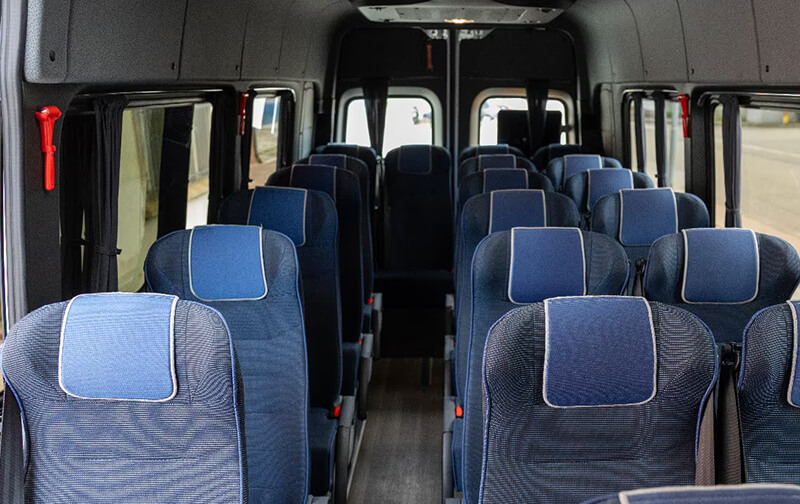
An accessible minibus has a lift or ramp and securement positions, and each wheelchair space replaces some seats. The mix of riders therefore decides the vehicle, and sometimes the number of vehicles.
What the rules do and don't cover
The Accessible Canada Act reaches federally regulated transport, which takes in bus carriers operating across provincial or international borders. Yet the federal accessible-transport regulations exclude charter services, and they also leave out any bus with 39 passenger seats or fewer. So on a private group trip, suitability comes down to the vehicle an operator can supply: accessibility is arranged booking by booking and never taken for granted.
Rules worth knowing
- Federal accessible-transport regulations apply to interprovincial and international bus carriers
- The Canada Place cruise terminal is covered by the federal regulations and takes part in the Hidden Disabilities Sunflower program
- At the Canadian Grand Prix, metro Line 4 is not accessible to people with limited mobility from Berri-UQAM station
Ports, events and outings
In Vancouver, the Canada Place terminal comes under the federal rules and participates in the Sunflower program for hidden disabilities, and Victoria's cruise terminal guide calls for every shuttle bus there to be wheelchair accessible. Near Halifax, Peggy's Cove offers an accessible viewing deck reached by long, gentle ramps, along with accessible parking and wheelchair-accessible washrooms, which makes it a good outing for mixed-mobility groups.
Going to the Canadian Grand Prix? The metro's Line 4 can't be used from Berri-UQAM by people with limited mobility, so settle the route to the circuit ahead of the weekend.
Your questions
Can a passenger stay in their wheelchair for the ride?
In a vehicle with securement positions, yes, as long as the chair can be secured. Tell us the chair type so the operator can confirm.
Will there be rest stops?
Put them in your timetable. On buses covered by the federal rules that have no accessible washroom, the carrier must, if asked, make a stop at least once every 2.5 hours; on a private trip, you set the stops.
Is an accessible vehicle always available?
Not always, which is why notice helps. We ask operators on your behalf, and the quote states the vehicle you will get.
Cities
Vehicles
- Full-size coach — 49-81 seats
- Midi coach — 29-35 seats
- Minibus — 16-19 seats
- Executive Sprinter van — 17-19 seats
- Executive car (sedan or SUV) — 1-3 seats
- Wheelchair-accessible minibus — Varies by layout; wheelchair positions replace seats